Traffic Is Down 21% Since 2018 | Hybrid Storytellers
The Weekly Table, No. 08. One number a week that restaurant owners can't ignore, what it means for a Pittsburgh-sized restaurant, and the play.
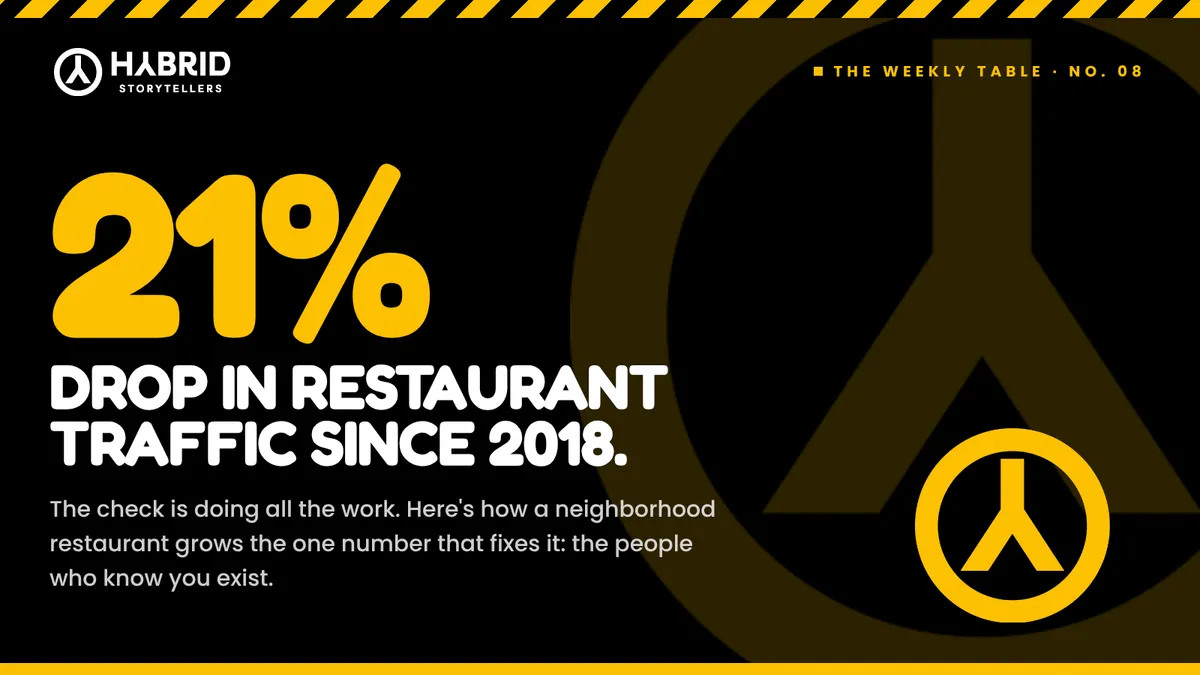
Restaurant traffic is down 21% since 2018. That's Black Box Intelligence's Victor Fernandez at the Restaurant Finance & Development Conference in Las Vegas last week, as reported by Nation's Restaurant News on November 13. Same-store sales are tracking to finish 2026 up 1.7%, better than 2024 and better than 2025, and he was candid about where that growth comes from: the average check is doing all the work. Fewer people are walking in. The ones who do are paying more.
The more useful number came from the same stage. Baird analyst Chris O'Cull looked at 335 million visits across 1,260 restaurants and eight chains and found that how often a guest comes back barely moves. A coffee shop gets you daily. A nice dinner spot gets you a few times a year. That's set by what you are. Chili's grew its customer count about 17% since 2017, and its total visits grew by the same amount. His line: traffic largely tracks the size of your customer base.
Read those two together and the whole traffic problem gets simpler. You don't fix a 21% hole by squeezing a fourth visit out of the people who already come three times. You fix it by growing the number of people who know you exist. And one more thing from that room: Placer.ai's R.J. Hottovy said independent restaurant sales are up, on better value and higher perceived quality. The chains are the ones bleeding guests. The neighborhood place has the advantage, if people can find it.
Here's what that means for a 60-seat room in Pittsburgh. Within a 15-minute drive of your door there are tens of thousands of households, and most of them have never been in. Not because they tried you and left. Because you've never crossed their screen. Your regulars are already doing their part. The growth is in the people who aren't regulars yet.
Three plays, no new software.
Play 1: Win the search you're not showing up for
Every night, someone a few miles away types "dinner near me" into Google, and the profile they see decides whether you make the list. That profile is your front door for strangers. Current hours, a menu that matches tonight's table, fresh photos every month, a reply on every review. None of it costs money. All of it decides whether a household that has never heard of you shows up on a Thursday.
The Turn Club in Cranberry is the proof. When we started shooting and posting monthly and kept the Google profile current, their Google views climbed past 184,000 and monthly site visits went from about 3,000 to more than 14,000. Same kitchen. Same menu. A much bigger customer base, because a much bigger slice of Cranberry could finally see it.
Play 2: Put the food in front of people who don't follow you yet
Your Instagram followers already know you. Growth is the share of people you reach who don't. That takes two things: content worth stopping for, which means a real shoot every month, short video of the plating, a face from the kitchen, and a small targeted ad budget that pushes the best of it to the zip codes within five miles of the door. Same photos that are already on Google and the site, now in front of strangers every week.
That's what we did at Sophia's in Coraopolis: a loyal local following, almost no online presence, no software added. We photographed the food, built a content rhythm, and ran small local ads to the right neighborhoods. New guests, week over week, and a general manager who told us "our food has never looked so good."
Play 3: Turn every first-timer into someone you can reach again
A new guest who leaves without giving you a way to reach them is a one-time visit you paid to acquire. A small offer for joining the email and text list, on the table, the receipt or a QR at the host stand, turns that night into a name on a list you own. Then the list does the work: the Tuesday special, the holiday menu, the gift card, delivered to people who already liked you once. Emiliano's Mexican Table built its list past 1,500 subscribers and turned it into 464 in-store redemptions in three months. Those were new faces becoming regulars, which is the only way a customer base actually grows.
That's the system we run for clients: a shoot every month, social content built from it, a Google profile that stays current, a list the restaurant owns, a site on the POS it already uses, and a small ad budget pointed at the right neighborhoods. Every piece of it is aimed at the same number: how many people in Pittsburgh know your room exists.
The number to watch this week
Open Instagram, go to Insights, and look at accounts reached over the last 30 days. Right under the total, it splits followers from non-followers. That non-follower share is your growth. If it's under 20%, you're talking to the same people every week, and the chains just told you where that leads. Post the plate, boost the best one to the neighborhoods you want, and check it again in 30 days. Traffic tracks the size of your customer base. This is how you watch it grow.
Sources: Nation's Restaurant News, "Takeaways from the Restaurant Finance & Development Conference," November 13, 2026: Black Box Intelligence chief insights officer Victor Fernandez said restaurant traffic is down 21% since 2018 and industry same-store sales are tracking up 1.7% for 2026 with average check carrying the growth; Baird analyst Chris O'Cull's analysis of 335 million visits at 1,260 restaurants across eight chains found visit frequency barely changes by concept, Chili's grew its customer count about 17% since 2017 with total visits up the same amount, and "traffic largely tracks the size of your customer base"; Placer.ai's R.J. Hottovy said independent restaurant sales are up on better value and higher perceived quality. Client figures from Google Business Profile and Sprout Social reporting for The Turn Club, Sophia's and Emiliano's Mexican Table, 2026.
Ryan Hreczkosiej is the founder of Hybrid Storytellers, a Pittsburgh restaurant marketing agency. If you'd like to see how the system would work in your restaurant, book a free 30-minute strategy call.