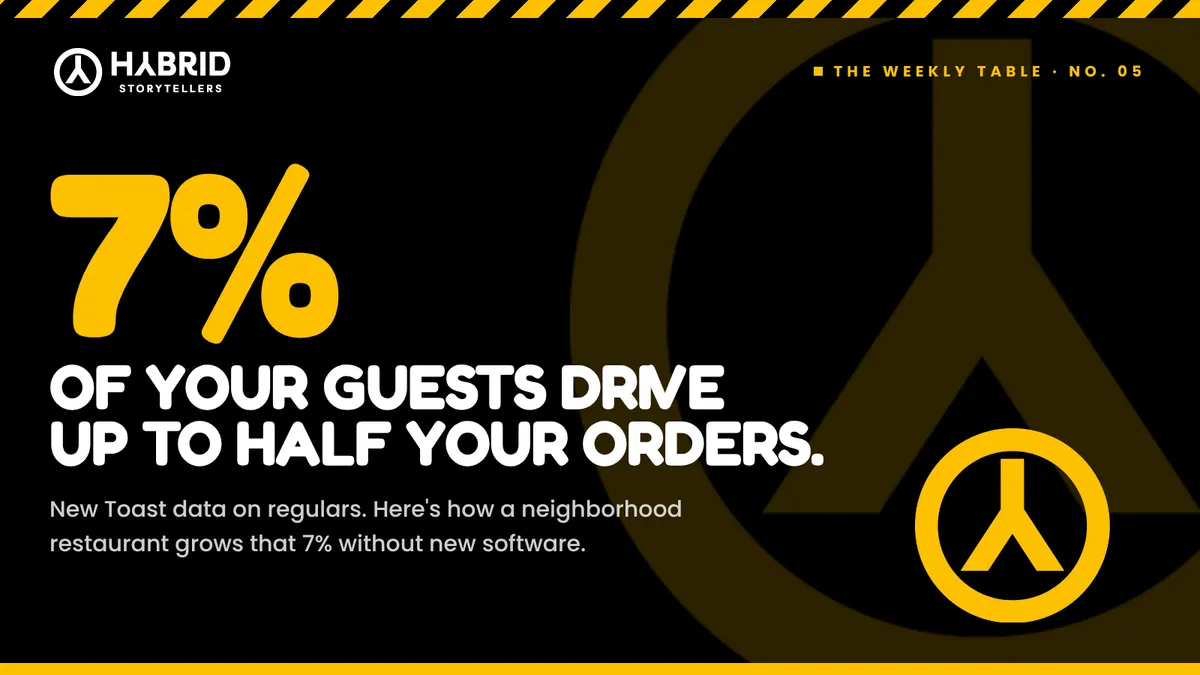
7% of Guests Drive Half Your Orders | Hybrid Storytellers
The Weekly Table, No. 05. One number a week that restaurant owners can't ignore, what it means for a Pittsburgh-sized restaurant, and the play.
Just 7% of a restaurant's guests come back more than once, and that 7% can drive up to half of its order volume. That's from Toast's Regulars Report, published October 15, built on transactions across its restaurants in the first quarter of 2026. It's the plainest case we've seen for where a small restaurant's money actually comes from.
The rest of the report explains why the regular is worth so much. In a survey of 1,500 people who eat out at least twice a month, 62% said they keep a short roster of two or three restaurants and rotate through them. 37% visit their favorite at least once a week. 34% spend more per check at a regular spot because they're comfortable ordering, and 77% tip more there. Ask what makes them feel most valued and the top answer, from 48%, is being remembered: a name, a usual order.
Now the flip side. 83% of the people who find a restaurant through a search engine never come back. Meanwhile, 86% of orders that came from a restaurant's own email and 83% from its texts came from people who had already eaten there. New guests are expensive and mostly one-and-done. Regulars are cheap to reach and keep showing up.
For a 60-seat room in Pittsburgh, do the math on your own numbers. If a thousand different people walk through the door in a quarter, about 70 of them are carrying half your tickets. Lose ten of those 70 to the place down the street and it costs more than any slow Tuesday. Add ten and you've grown without spending a dollar on reach.
The chains chase the regular with apps and points. A neighborhood restaurant needs neither. It needs a reason to come back, a way to reach the people who already came, and a feed that makes them feel known. Three plays, no new software.
Play 1: Get on the roster with a ritual
62% of diners keep a roster of two or three places. The way onto it is predictability. Pick one thing that happens the same way every week: a Wednesday special, a Friday fish, a Sunday family tray, a Thursday half-price bottle. Give it a name, shoot it once properly, and post it on the same day every week on Instagram, Facebook and your Google Business Profile. Guests don't memorize a menu. They memorize "that's the Wednesday place."
At Sophia's, the weekly specials card is the steadiest post on the account. It's never the viral one, but it reliably pulls clicks every single week, because the regulars have learned to look for it. That's the ritual working.
Play 2: Reach the 7% directly
The report's email and text numbers are the whole argument for an owned list. The people who open your email are overwhelmingly people who've already eaten with you, which means every send is a nudge to a regular, not a gamble on a stranger. Capture them in the room: a line on the receipt, a card on the table, a QR at the host stand, "join the list, get the weekly special first." Then one send a week, one photo, one reason to come in. Nothing else.
At Emiliano's Mexican Table, the list we built from in-room signups and the site now has more than 1,500 names, and a single offer sent to it produced 464 redemptions. Those weren't new customers. They were regulars given a reason to come in on a specific night.
Play 3: Make the regular feel known on camera
Being remembered is what 48% of guests value most, and your social feed is where that happens at scale. Shoot the people, not just the plates: the bartender who knows the pour, the server who's been there since opening, the regular who comes in every Friday (ask first, then tag them). Pair it with a current Google profile, because the same regular who follows you on Instagram still searches your hours before they get in the car. If you want to spend a little on ads, keep them within a few miles of the door, pointed at people who already follow you or have visited the site. You're reminding, not introducing.
At Convive Coffee, staff-led posts consistently beat product shots, including the run of posts following Paulo to the World Barista Championship this month. People come back to people.
That's the system we run for clients: a shoot every month, social content built around a weekly ritual, a Google profile that stays current, a list the restaurant owns, and a site tied to the POS it already uses. The point isn't more strangers. It's a bigger 7%.
The number to watch this week
Names on your list. Count how many you have today, and how many you added by Sunday. If the answer is zero both times, that's the first fix, and it takes a sign and a sentence from your servers. If the number is growing, you're building the only audience that's cheaper to reach next month than it was this month. The 7% are already in your dining room this week. Get their names before they leave.
Sources: Toast, The Regulars Report 2026, published October 15, 2026: Toast platform data from Q1 2026 shows 7% of a business's guest base is multi-visit and up to 50% of volume can come from that 7%; 86% of orders originating from email marketing and 83% from SMS came from people who had already dined at the restaurant; 83% of search-engine visitors are one-and-done. Consumer survey (1,500 U.S. adults who dine out or order in at least twice a month, fielded April 2, 2026): 62% maintain a roster of two or three restaurants; 37% visit their favorite at least weekly; 34% spend more per check at a regular spot; 77% tip more; 48% say being remembered matters most. Client figures from Hybrid Storytellers campaign data and Sprout Social reporting, August 5 to October 6, 2026.
Ryan Hreczkosiej is the founder of Hybrid Storytellers, a Pittsburgh restaurant marketing agency. If you'd like to see how the system would work in your restaurant, book a free 30-minute strategy call.